

Cape Town’s Airbnb crisis Is Creating a Hidden Waste Problem — Here’s Why It Matters…
Step outside in Cape Town on a windy day, and you’ll see it.
Plastic caught in fences.
Packaging drifting down streets.
Waste that didn’t just “disappear” after it was thrown away.
Now zoom in — into a Sea Point apartment, a Camps Bay villa, or a CBD studio preparing for its next guest.
Fresh sheets.
Quick reset.
Surfaces wiped down.
And then it happens again.
And again.
And again.
Because this isn’t occasional hospitality anymore.
It’s scale.
A city built on constant turnover
Cape Town has quietly become one of the most saturated short-term rental markets in the world.
Today, there are an estimated 26,000 to over 30,000 active Airbnb listings across the city.
In certain parts of the CBD, that concentration is even more intense — with reports suggesting up to 70% of residential units are used as short-term rentals.
This isn’t just tourism.
It’s a system.
And that system runs on one thing:
Constant turnover.
With average occupancy rates sitting between 60% and 70%, a single property can be cleaned 15 to 20 times every month.
Now multiply that across tens of thousands of listings.
What you get isn’t a few extra cleans.
It’s hundreds of thousands of cleaning cycles happening every single month.
The hidden layer no one is talking about
Every one of those cleans uses:
Cleaning chemicals
Plastic packaging
Water and energy
And because Airbnb operations are decentralised, there’s no consistent standard for how this is managed.
In some parts of Cape Town, there are 13.5 Airbnb units for every one long-term rental property.
Which means the rate of consumption is massively amplified — quietly, and largely untracked.
This isn’t about blaming hosts or cleaners.
It’s about recognising what the system actually demands.
Why this matters more in Cape Town
Cape Town is already a city under pressure.
Property prices have increased by 31% in just five years
The population has grown by over 65% since 2001
Infrastructure is being stretched.
Waste systems are under strain.
And layered on top of that is an industry that depends on:
More bookings.
More turnover.
More cleaning.
More consumption.
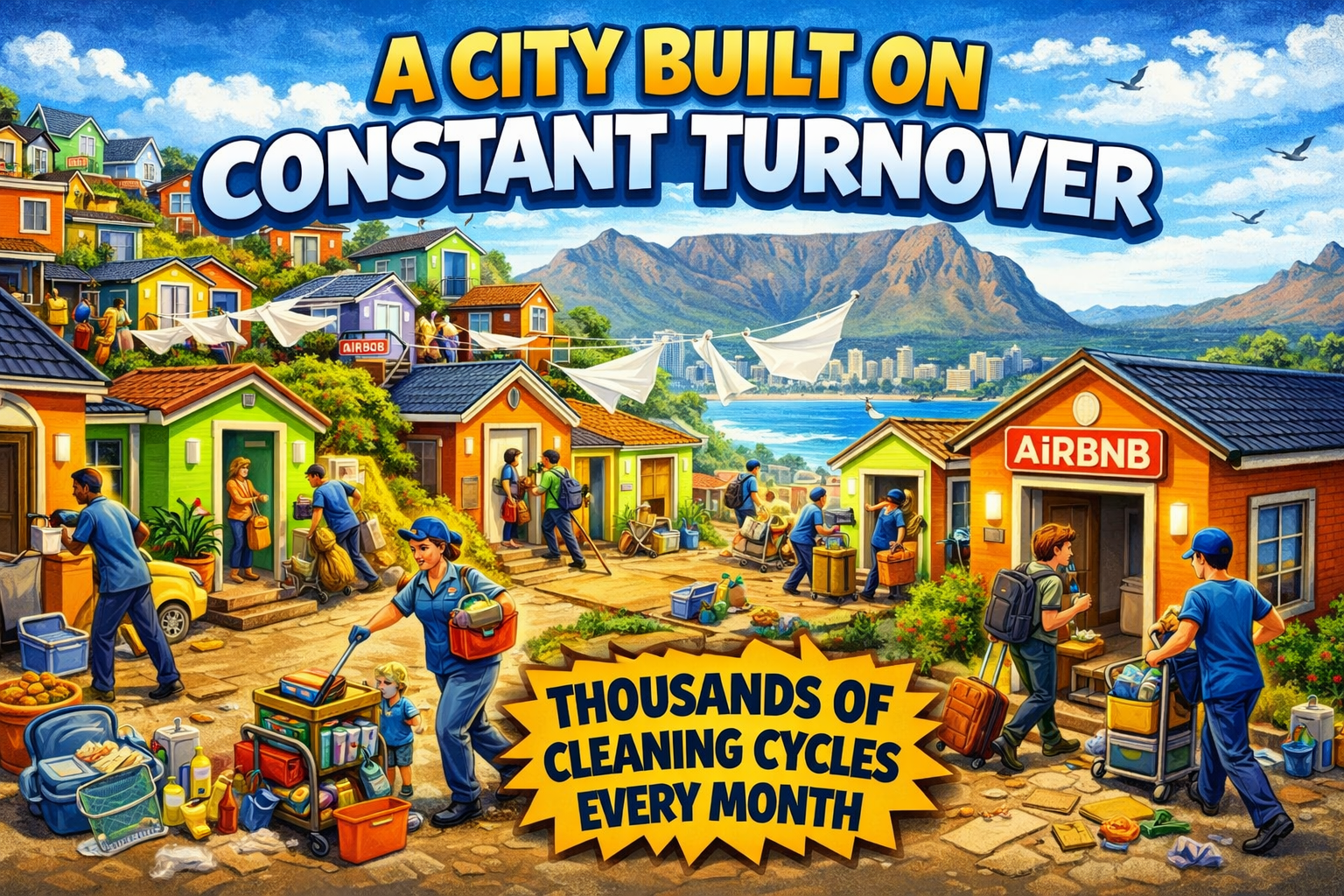
A depiction of Cape Town’s high - volume cleaning demands.
This isn’t just a housing story — it’s an operational one
Most conversations around Airbnb focus on affordability and regulation.
But there’s another side to it.
A quieter one.
A system where:
Products are used fast and replaced constantly
Plastic waste is generated daily
Chemicals enter water systems at scale
Not because anyone set out to create waste.
But because the model was never designed to avoid it.
A smarter way to run high-turnover properties
If Cape Town is serious about sustainability, this is where the shift has to happen.
Not by slowing down operations —
But by making them smarter.
That means:
Concentrated cleaning products that last significantly longer
Refillable systems that reduce single-use plastic
Non-toxic formulations safer for both people and the environment
Less waste.
Fewer deliveries.
More efficient systems.
Where Macsol fits in
At Macsol, we’ve built our products around exactly this kind of environment.
High-use.
Fast-paced.
No room for inefficiency.
Whether it’s bulk supply, ready-to-use formats, or concentrated solutions — the goal is simple:
Reduce waste at the source, without compromising performance.
Because in a city like Cape Town, sustainability isn’t just a marketing angle anymore.
It’s becoming part of how responsible businesses operate.
Final thought
Cape Town’s Airbnb boom isn’t slowing down.
But the way it operates?
That has to evolve.
Because the real cost of convenience isn’t always visible.
Until you start looking at what gets used, replaced, and thrown away — every single day.
And when you do, one thing becomes clear:
The biggest opportunity for change isn’t just in where people stay.
It’s in how those spaces are run.
